North Korean hackers ran US-based “laptop farm” from Arizona woman’s home – Ars Technica

https://arstechnica.com/security/2025/07/north-korean-hackers-ran-us-based-laptop-farm-from-arizona-womans-home/

Christina Chapman, a 50-year-old Arizona woman, has just been sentenced to 102 months in prison for helping North Korean hackers steal US identities in order to get „remote“ IT jobs with more than 300 American companies, including Nike. The scheme funneled millions of dollars to the North Korean state.

Why did Chapman do it? In a letter sent this week to the judge, Chapman said that she was „looking for a job that was Monday through Friday that would allow me to be present for my mom“ who was battling cancer. (Her mother died in 2023.) But „the area where we lived didn't provide for a lot of job opportunities that fit what I needed. I also thought that the job was allowing me to help others.“

She offered her „deepest and sincerest apologies to any person who was harmed by my actions,“ thanked the FBI for busting her, and said that when she gets out of prison, she hopes to „pursue the books that I have been working on writing and starting my own underwear company.“

Managing all this fraud required plenty of tedious bureaucracy. The North Koreans had to steal US identities, of course, but then they also had to, you know, get hired. This involved endless paperwork, such as writing resumes and filling out I-9 forms to show eligibility to work in the US. (In one chat, Chapman said that she was happy to send I-9 forms from her home address but that she would prefer not to „do the paperwork“ herself because „I can go to FEDERAL PRISON for falsifying federal documents.“)

Chapman was also key to the less obvious, more technical part of the scheme—how to make it appear like all these remote workers were actually living in the country.

Laptop farm

When her clients got hired, Chapman would receive their corporate laptops in the mail. Sometimes she would re-ship them to „a city in China on the border with North Korea.“

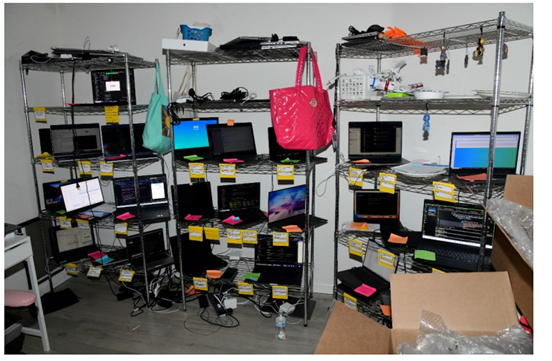
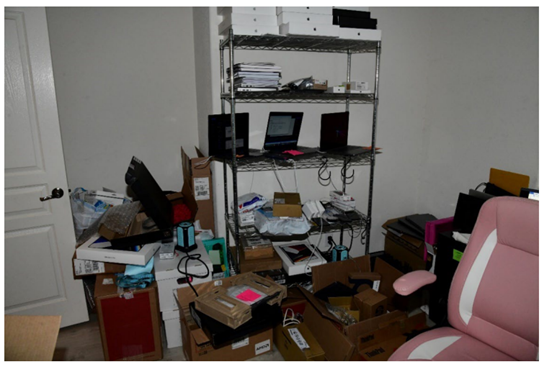
But she kept more than 90 of the machines at her place in Arizona. Using proxies, VPNs, and remote-access software like Anydesk, the North Koreans logged in to their „American“ computers from afar and then appeared to be normal, US-based remote employees, showing up to staff meetings on Zoom, collecting paychecks, and occasionally exfiltrating data or installing ransomware.

As the number of computers mounted, Chapman began stacking them on shelves around her residence, labeling them with sticky notes so she could remember which „worker“ and company controlled which machine. When Chapman's home was searched, FBI agents took photos of her setup, which is… something to behold, really.

Chapman's origin story is a sad one. According to her public defender, her childhood was marked by „her father’s infidelity, alcoholism, and emotional absence.“ Chapman was placed in 12 different schools across multiple states before she graduated high school, „leaving her socially isolated, bullied, and unable to form lasting friendships or a sense of belonging.“ She also suffered „severe and escalating violence from her older brother, who repeatedly beat and choked her, held a shotgun to her chest, and once left her so visibly bruised that her school intervened.“ And she was „sexually abused at various points in her childhood and adolescence by family members, peers, and even individuals she believed to be friends.“

Unfortunately, Chapman's poor choice to involve herself with the North Koreans inflicted plenty of pain on others, too, including those whose identity was stolen. One victim told the court that the crime „left me feeling violated, helpless, and afraid,“ adding:

Although identity theft is not a physical assault, the psychological and financial damage is lasting. It feels like someone broke into my life, impersonated me, and left me to pick up the pieces. There is a lingering fear that my information is still out there, ready to be misused again. The stigma of being a fraud victim also weighs heavily; I have had to explain myself to banks, creditors, and sometimes even to people I know. There is an ongoing sense of vulnerability and lack of control.

In addition to her 8.5-year sentence, Chapman will serve three years of „supervised release,“ must forfeit $284,555 that was meant for the North Koreans, and must repay $176,850 of her own money.

Such „remote work“ scams have become increasingly common over the last few years, most originating from North Korea, and the FBI has released repeated guidance on what to look for when hiring remote workers.

Deti trávia prázdniny aj na sociálnych sieťach. Ombudman upozornil na hrozivé čísla – SME

https://domov.sme.sk/c/23521420/deti-travia-prazdniny-aj-na-socialnych-sietach-ombudman-upozornil-na-hrozive-cisla.html?ref=mnt

Takmer polovica detí (47,9 percenta) trávi extrémne veľa času na sociálnych sieťach a v online prostredí, a to viac ako štyri hodiny denne.

Vyplýva to z tohtoročného celoslovenského prieskumu názorov detí, v ktorom Úrad komisára pre deti okrem iného zisťoval aj to, koľko času trávia deti online.

Komisár pre deti Jozef Mikloško zdôrazňuje, že online kontakt nenahrádza skutočné vzťahy, informovala Iveta Adamová z Úradu komisára pre deti.

Až 11,5 percenta detí trávi na sociálnych sieťach viac ako šesť hodín denne. Hoci ide o mierny pokles oproti dátam z prieskumu z roku 2022, stále je to podľa komisára hrozivé číslo.

Mikloško upozorňuje, že deti si neuvedomujú hrozby spojené s digitálnym svetom, hoci tie môžu súvisieť so zhoršením ich psychického zdravia.

Z prieskumu takisto vyplýva, že 27,3 percenta detí trávi so svojimi rodičmi menej ako tri hodiny denne. „Menej spoločného času tráveného s rodičmi môže prispievať k dlhšiemu času, ktorý deti strávia v online prostredí,“ podotkol Mikloško.

V porovnaní s rokom 2022 najviac poklesla spokojnosť detí s počtom sledovateľov na sociálnych sieťach. Až 40 percent detí uvádza významnú nespokojnosť s ich počtom. „Ukazuje sa, že deti sú citlivé na online uznanie a porovnávanie,“ konštatoval Mikloško.

Keďže prieskum bol vykonaný na siedmakoch základných škôl (vek 12 až 13 rokov), pri týchto údajoch je podľa komisára zrejmé, že deti sa registrujú na sociálnych sieťach omnoho skôr, než je minimálny povolený vek na registráciu.

Prieskum ukázal aj to, že online vzťahy sú slabé v dôvere aj v pocite bezpečia. Online priateľstvá nemajú pre deti takú dôležitosť ani dôveru, ako sa často predpokladá. Osobné vzťahy (najmä rodina a kamaráti v reálnom živote) zostávajú zásadné.

„Najmenej bezpečne sa deti cítia s online kamarátmi (len 11,3 percenta). Deti v prieskume v časti o využívaní online technológií uviedli, že o veciach, ktoré ich trápia, by online kamarátom povedalo len 6,1 percenta z nich. Oproti tomu reálnym kamarátom by sa zdôverilo až 77 percent detí,“ sumarizoval Mikloško.

Prieskum ukázal aj to, že online vzťahy sú slabé v dôvere aj v pocite bezpečia. Online priateľstvá nemajú pre deti takú dôležitosť ani dôveru, ako sa často predpokladá. Osobné vzťahy (najmä rodina a kamaráti v reálnom živote) zostávajú zásadné.

„Najmenej bezpečne sa deti cítia s online kamarátmi (len 11,3 percenta). Deti v prieskume v časti o využívaní online technológií uviedli, že o veciach, ktoré ich trápia, by online kamarátom povedalo len 6,1 percenta z nich. Oproti tomu reálnym kamarátom by sa zdôverilo až 77 percent detí,“ sumarizoval Mikloško.

Nuclear power in cabinets: Japan’s "Little Iron Man" helps villages and towns get electricity – iMedia

https://min.news/en/science/b3fc3ebc66a3f29a8e0447fbda105a5a.html

Nuclear power in cabinets: Japan's „Little Iron Man“ helps villages and towns get electricity

2025-07-18 01:43

On the snowy outskirts of Hokkaido , a modular micro reactor the size of a container, the Yoroi Reactor, was unveiled, heralding a disruptive innovation in Japan's clean energy sector.

It was jointly developed by a private consortium and the National Institute of Fusion Science of Japan, using molten salt cooling and ceramic-based low- enriched uranium fuel, integrating power generation, control, and heat dissipation, and packaged in a standard 40-foot container for easy transportation by truck or ship.

It is buried underground after being deployed on site, requiring no external operation, and can be called a „maintenance-free nuclear battery “ version.

Nuclear power in cabinets: Japan's

1. Design concept: small size, high energy, autonomous safety

Traditional commercial nuclear power plants are large in size, have a long construction period, and are highly dependent on geology and water sources.

The „Armor“ microreactor is 3 meters high, 4 meters wide, weighs less than 40 tons, has a thermal power of 1 megawatt, and can convert about 0.5 megawatts of electricity, continuously providing electricity for the town for decades.

Its core and molten salt coolant are chemically stable, with low operating pressure, no active cooling circuit required, and can be passively shut down once the power is off, completely eliminating the risk of meltdown.

2. Operation and maintenance mode: the revolution of “ reactor as battery“

The fuel use cycle of each unit is as long as 10 years. At that time, the overall containerized reactor will be towed back to the factory to replace the new module, just like replacing the „nuclear power battery“.

This move not only greatly reduces the pressure of on-site radiation and waste management, but also avoids the complicated local disassembly and fuel handling procedures.

Due to the high degree of integration, the local area only needs to maintain the basic grid connection, truly realizing the convenient microgrid deployment of „install and use, retire and go“.

3. Japanese policy: SMR becomes a new energy lever

After the Fukushima accident, Japan's cautious attitude towards nuclear power has given rise to a strong demand for small modular reactors (SMRs).

The Financial Times reported that the Japanese government has listed SMRs as an important supplement to the energy structure before 2030, and plans to increase the proportion of nuclear power in total power generation to 20% by 2040.

To achieve this goal, several conventional nuclear power plants, including the Tomari Unit 3 in Hokkaido, have been restarted, and a roadmap for SMR demonstration projects has been developed.

4. Industrial layout: acceleration from R&D to demonstration

Mitsubishi Heavy Industries' „road reactor“:

Mitsubishi Heavy Industries plans to mass-produce a 1-megawatt micro reactor that can be transported by truck by the early 2030s. The unit and power generation equipment are packaged in an ISO container, weighing less than 40 tons, with passive cooling and all-weather operation capabilities. Demonstration operation will be carried out in remote islands and disaster areas in the early stage.

Radiant Nuclear's „Kaleidos“ :

The Kaleidos microreactor developed by Radiant of the United States has a production capacity of 1.2 megawatts. It is based on high-temperature gas-cooled pellet fuel. The entire machine is loaded into a single container. It is aimed to start testing in 2026 and commercialization in 2028, highlighting the global research and development boom of microreactors.

International cooperation and standards :

The Japan Atomic Industries Forum (JAIF) actively participates in the construction of the international SMR database and cooperates with organizations such as the IAEA to develop safety and regulatory standards for small reactors to promote the rapid implementation of demonstration projects.

5. Application prospects: „Clean Gospel“ for towns, disaster areas and off-grid communities

Remote towns and villages :

For mountainous areas and islands where grid construction is expensive, the Armor can provide stable, zero-emission baseload electricity, allowing local schools, hospitals and communication base stations to operate around the clock.

Disaster emergency response :

In Japan, where earthquakes, typhoons and other natural disasters are frequent, the „maintenance-free, buryable“ microreactor can quickly restore electricity after a disaster to ensure that rescue and basic services are not interrupted.

Off-grid areas :

Around the world, including the Alaskan wilderness and remote mining areas in Africa, containerized microreactors can be used to achieve self-sufficient energy, reducing dependence on diesel generators and reducing carbon footprint.

6. Challenges and countermeasures: safety trust and cost test

Although passive safety design has greatly reduced the risk of accidents, the public still has deep-rooted concerns about the „nuclear“ element.

In the promotion of demonstration projects, it is necessary to strengthen community communication, make operation and monitoring data transparent, and build a trust chain between government, enterprises and the public;

at the same time, through large-scale production, modular assembly and international cooperation, strive to reduce the cost per megawatt to a level that can compete with large-scale wind power and photovoltaic projects.

7. Looking to the future: Towards a new era of green „nuclear grid integration“

With the maturity of technology and the improvement of regulatory systems, container-level micro nuclear reactors are expected to become an important supplement to Japan's and even the world's energy layout.

Combined with wind and solar complementarity and smart microgrids, they can release the „last mile“ value in energy transformation: without geographical and climate restrictions, they can provide continuous, safe and low-carbon power support for remote and vulnerable areas.

In short, the „Armor“ container microreactor represents the „small and beautiful“ route of nuclear energy : no cooling tower is required , no continuous operating personnel are required, and nuclear power is truly integrated into daily life „like a battery“, bringing double returns for ecological and economic benefits.